Description
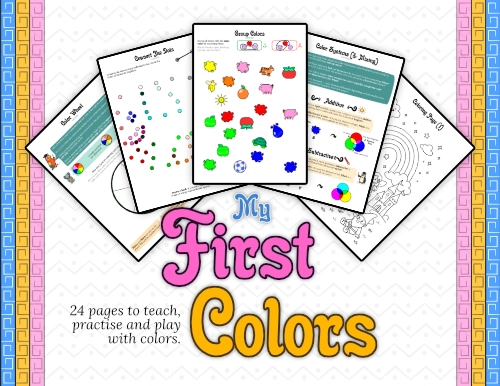
Shapes and colors are some of the first things that children learn to consciously recognize and play with. This resource teaches the very simple basics first, then combines them for maximum effect, and then goes beyond that by presenting them in weird configurations (such as slightly different shades of the same color).
You might be surprised by how early (and easily) young brains can pick up on this. That’s probably because it is a very natural first step to understanding more complex things in the world. Because, after all, what is a tiger, or a chair, or a smartphone, if not an amalgamation of basic shapes and colors?
Important Note: Many (educational) resources on colors are simply wrong. They repeat the same misinformation that can cause trouble later, such as that Red, Blue and Yellow are “the” primary colors. There are two systems of color—additive (light) and subtractive (ink/print)—which behave differently, neither of which are well-served by choosing RBY as your primary colors. Yes, you can pick any colors as you primaries! But some choices are worse than others and will only lead to a small range of dull colors that you can make.
This resource, therefore, approaches some things differently to give a proper explanation, while staying simple and fun!
This resource only explores colors, and some combined exercises with shapes. Check out My First Shapes to learn about shapes in the first place!
Details
- ✔️ Pay once, use forever, however.
- ✔️ No hidden costs or data tracking.
- ✔️ No sign-up required.
- ✔️ No difficult licenses or restrictions.
- ✔️ Instantly arrives in your inbox. (Check spam folder!)
- ✔️ Fun and effective!
Product Contents
- Explainer Basic Colors
- Connect Same Colors I
- Group Same Colors I
- Color Tarsia I
- Color Wheel/Circle Explained (Simple)
- Explainer Advanced Colors
- Connect Same Colors II
- Group Same Colors II
- Color Tarsia II
- Color Wheel Game (Advanced)
- Combined Exercise; color all shapes X color Y.
- Color Variations (different shades, brightness/darkness, etc)
- Connect Same (Saturation / Brightness)
- Connect the Dots + Connect the Dots Color Wheel
- Color Systems (mixing colors, additive and subtractive mode)
- Activity Ideas/Examples
- 3 fun coloring pages to let loose your own creativity
Fine Details
| Detail | Value |
| Age | 3 |
| Categories | colors |
| Color | true |
| Language | en |
| Level | 1 |
| Subject | mathematics |
| Textless | true |
Subject: Mathematics
The curriculum is split into six main subjects that align with your typical school subjects.
This resource is part of the Mathematics subject. Below is a summary:
This subject teaches Mathematics from first principles to calculus. Level 1 explores the basic skills needed before you do any counting or see any numbers (such as grouping and comparing objects). Level 2(+) can then introduce numbers, counting, addition, multiplication, and more.

Faction: Teachers
This resource is part of the Teachers Faction.
But that's just one way to teach and explore its topic(s)!
You can always move to a different Faction to find a more effective way to teach the same topic.
Played a quiz? Try a game! Played a game? Try an escape room! And so on.
For example,
Charm: Lesson Material
This product is part of the Lesson Material charm.
Visit its main page to learn more about what that means. Below is a summary:
Lesson Material refers to anything you can directly use in a classroom or when homeschooling. They are a guide for Guardians so they know what to do/teach, as well as the textbook or initial explanation of a skill/topic for Apprentices.
This charm represents the base product of our curriculum and the type of resource you’d use in a typical school setting.
Spell: My First Colors
This resource is part of the My First Colors topic (or "spell").
To learn mathematics, you need to be able to identify, compare, and group things. Colors are the easiest way to do this, because they’re visual and all around you. Teaching about colors allows Apprentices to play games or do puzzles, as well as unlock their creativity by drawing.
Use the buttons below to navigate to the previous or next topic in the curriculum.