Description
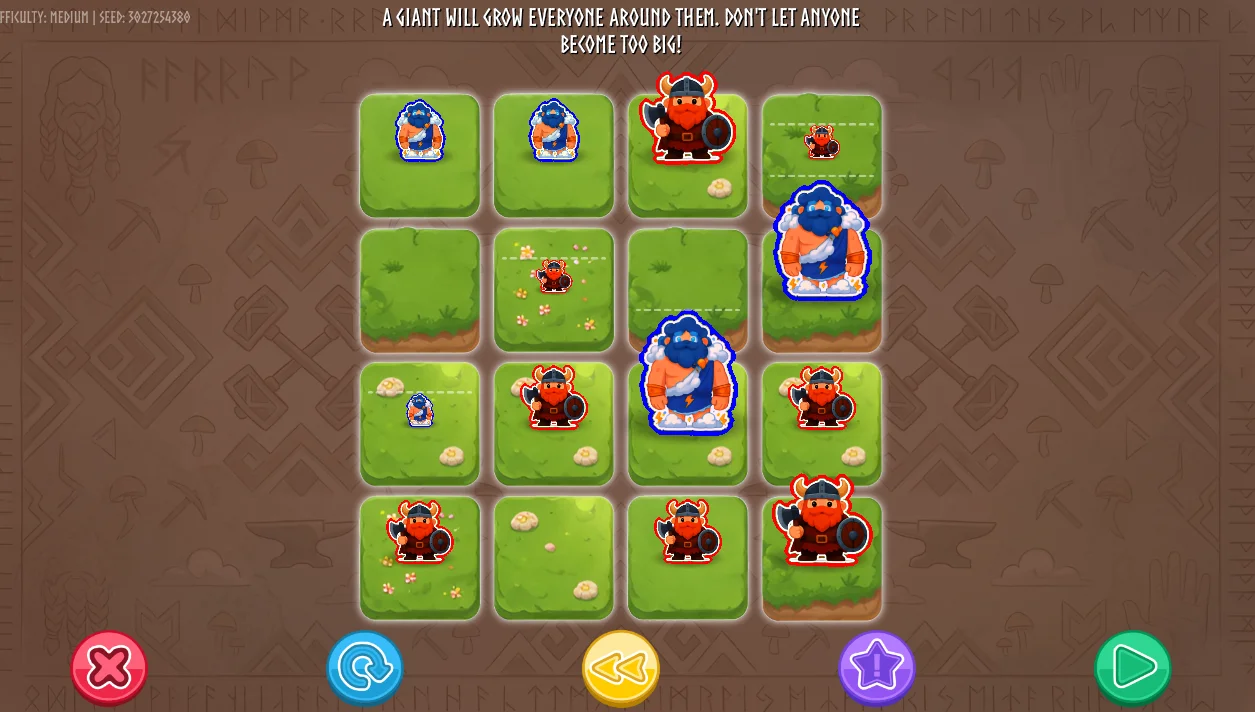
Dwarfs & Giants is a digital puzzle game teaching comparing, mostly focused on size (which is larger?) and overall look (dwarf or giant?).
On the easiest difficulty,
- You get a tiny map with dwarfs and giants.
- All of them are different sizes.
- Simply Tap them in order from smallest to largest
An easy and effective way to teach anyone the idea of size differences and sequencing from small to large.
As usual, though, our puzzle contains 5 difficulty levels! Later difficulties add simple rules that turn it into a more challenging and exciting puzzle. For example, giants grow everyone around them, and nobody is allowed to become too big.
As expected, the game has no text, numbers, or complex actions. Just tap the character you think is the smallest right now. Thanks to these clever rules, though, it is an actual puzzle that will challenge older kids and adults too at the hardest difficulties.
Have fun and keep learning!
Details
- ✔️ Pay once, use forever, however.
- ✔️ No hidden costs or data tracking.
- ✔️ No sign-up required.
- ✔️ No difficult licenses or restrictions.
- ✔️ Instantly arrives in your inbox. (Check spam folder!)
- ✔️ Fun and effective!
Product Contents
- The puzzle game for Windows, Mac, Linux, and Browsers.
Fine Details
| Detail | Value |
| Age | 2 |
| Categories | sequencing |
| Interactive Media | true |
| Language | en |
| Level | 1 |
| Player Count | 1 |
| Subject | mathematics |
| Textless | true |
Subject: Mathematics
The curriculum is split into six main subjects that align with your typical school subjects.
This resource is part of the Mathematics subject. Below is a summary:
This subject teaches Mathematics from first principles to calculus. Level 1 explores the basic skills needed before you do any counting or see any numbers (such as grouping and comparing objects). Level 2(+) can then introduce numbers, counting, addition, multiplication, and more.
Faction: Puzzlepages
This resource is part of the Puzzlepages Faction.
But that's just one way to teach and explore its topic(s)!
You can always move to a different Faction to find a more effective way to teach the same topic.
Played a quiz? Try a game! Played a game? Try an escape room! And so on.
For example,
Charm: Puzzle Game
This product is part of the Puzzle Game charm.
Visit its main page to learn more about what that means. Below is a summary:
These are digital games that offer fun little challenges for Apprentices to solve, letting them explore and practice a topic all on their own. Most games do not require reading, counting, or computer skills (unless they specifically teach those things), and always offer endless puzzles at five different difficulty levels.
Check out How To Install Our Games for help.
Spell: My First Comparisons
This resource is part of the My First Comparisons topic (or "spell").
Earlier topics taught Apprentices to identify if things are the same or not. This topic takes the next step: HOW are they different? This also gently introduces the idea of sequencing: putting things in order based on … something.
Use the buttons below to navigate to the previous or next topic in the curriculum.