Description
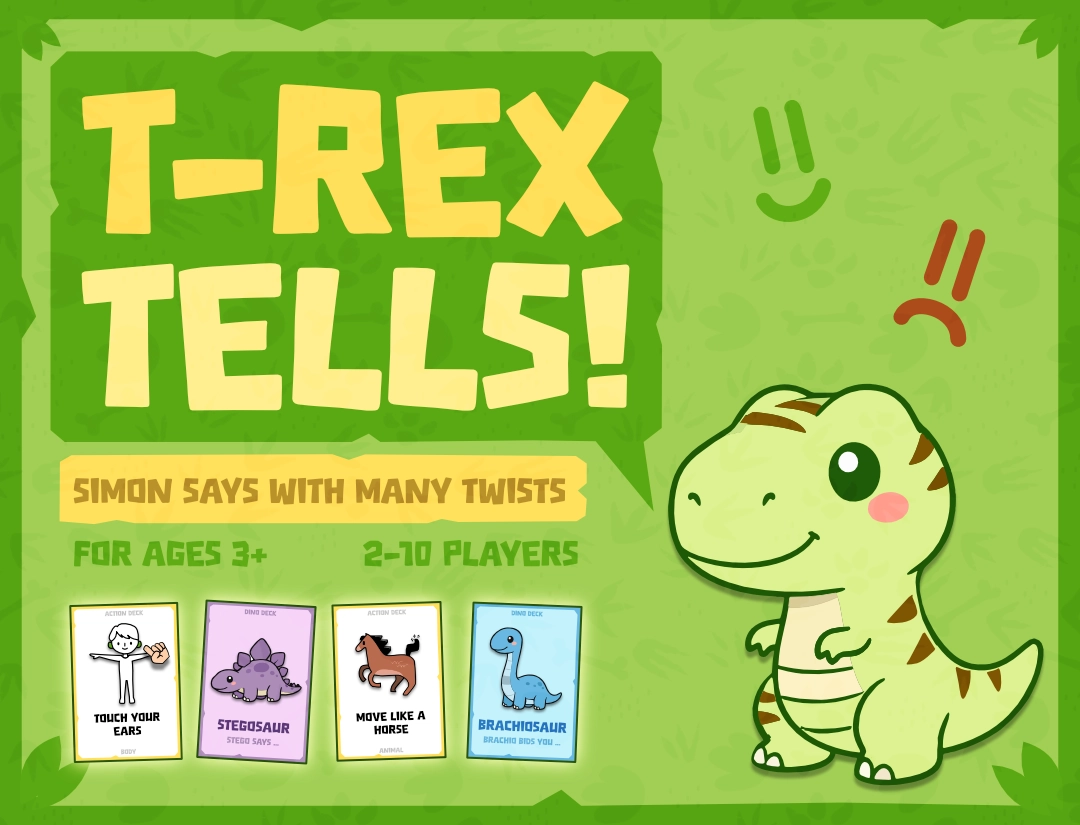
T-Rex Tells is basically an educational (board) game version of Simon Says. Every round, reveal two cards, one from a “dino deck” and one from an “action deck”. All players must immediately execute the action shown … but only if there’s a dino in front of it!
It’s a great game for children to learn “discrimination” of objects. They must watch for the simplest of differences—dino or not?—and act differently based on what they see. By combining it with a deck of “movements”, players get their exercise while learning this crucial skill.
For clarity, the cards contain English text descriptions of their action too. But this game can be enjoyed in any language, because you only need to know the rules and recognize clear images. That’s why we made this game! To immediately give you fun cards and simple rules to play a better version of “Simon Says” with any group.
We also added a large number of optional expansion cards for older players. Those contain a written description of a more complicated action or movement, such as adding two numbers. These cards work together perfectly with the other cards and expansions, keeping the game fun and challenging at all ages.
The vast majority of the game material are those “Action Cards”, which is why we made those as “ink friendly” as possible. They’re almost completely white. The other cards have more color and design to them because there’s far fewer of them. We couldn’t make the entire game grayscale (for maximum ink saving) this time because there are numerous cards for which color matters.
We realize, though, that these cards are still only a subset of all possibilities (in terms of commands and gameplay) with this idea. That’s why we also provide the original, editable, raw assets so you can customize them however you want.
Details
- ✔️ Pay once, use forever, however.
- ✔️ No hidden costs or data tracking.
- ✔️ No sign-up required.
- ✔️ No difficult licenses or restrictions.
- ✔️ Instantly arrives in your inbox. (Check spam folder!)
- ✔️ Fun and effective!
Product Contents
- Rulebook PDF (1 page base game, 2 pages with upgrades)
- Material PDF (10 pages with Dino, Action and Heart cards, some have an optional backside)
- Material Expansions PDF (9 pages with special cards for optional expansions)
- The raw assets (illustrations, layout file, etc) for you to view/edit. (As
.affiles, which you can open with the free Affinity software.)
Fine Details
| Detail | Value |
| Activity Structure | simultaneous |
| Age | 4 |
| Categories | shapes, colors |
| Color | true |
| Duration | 15 |
| Language | en |
| Level | 1 |
| Multiplayer Mode | cooperative, competitive |
| Player Count | 2, 3, 4, 5, 6, 7, 8, 9, 10 |
| Subject | mathematics, skills |
| Textless | true |
Subject: Mathematics
The curriculum is split into six main subjects that align with your typical school subjects.
This resource is part of the Mathematics subject. Below is a summary:
This subject teaches Mathematics from first principles to calculus. Level 1 explores the basic skills needed before you do any counting or see any numbers (such as grouping and comparing objects). Level 2(+) can then introduce numbers, counting, addition, multiplication, and more.

Faction: Gamiverses
This resource is part of the Gamiverses Faction.
But that's just one way to teach and explore its topic(s)!
You can always move to a different Faction to find a more effective way to teach the same topic.
Played a quiz? Try a game! Played a game? Try an escape room! And so on.
For example,
Charm: Board Game
This product is part of the Board Game charm.
Visit its main page to learn more about what that means. Below is a summary:
Board Games are simply physical games (as opposed to video games). They could be played using cards, without a board, with players physically moving around, anything.
Our board games follow the rule that your first game should only require a single page of setup + rules. Most of them are cooperative multiplayer experiences.
Spell: Recognition & Discrimination
This resource is part of the Recognition & Discrimination topic (or "spell").
A crucial first step to Mathematics and Logic is the ability to recognize things are the same or not. To discriminate between alike things.
This resource also covers other topics. To keep things simple, the curriculum always considers the first topic listed to be the most important.
Use the buttons below to navigate to the previous or next topic in the curriculum.