Description
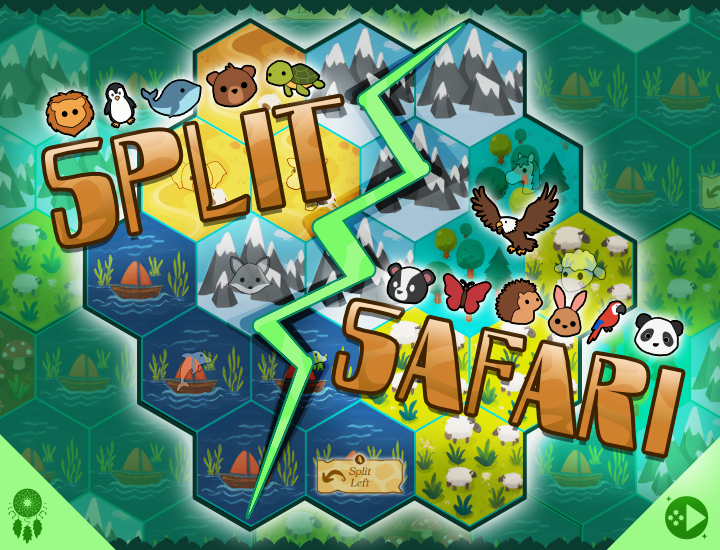
Split Safari is the biggest and most ambitious game from the “Comparisons” topic. Not because it’s hard to learn or play, no, because it’s so simple to learn that we think any kid will love it!
In this game, you’re racing over a random map. First player to reach the finish wins. How do you do that?
- Each round, everyone draws new cards. (These can just be open on the table, no need to keep them in hand or anything.)
- You split your cards into two groups, however you like.
- Now you offer these groups to your neighbor. They pick one they like (and get all its cards); you get the other group back.
At the end of each round, players will be left with a few Animal Cards, and hopefully ones that they like and chose. You can use them to move over the map! A Sheep will move you to a grass tile, a Whale moves you over water, and so forth.
That’s the whole game. Each round, you compare and ask yourself: “do I want this group of cards or that other group?” Then, you compare your cards with the map and see if you can move a few spaces forward. Because there’s so little randomness or distractions, though, it’s a real tactical game that offers real interesting choices to kids already.
Once you’ve played it a few times, you can add expansions, such as new terrain types, new animals, a dinosaur that chases you, and more. Especially with expansions enabled, this is a game that adults will love to play too. The colorful safari theme makes the game pop off the table, while there are no text, numbers or complicated rules that might confuse anyone.
Give it a try!
Details
- ✔️ Pay once, use forever, however.
- ✔️ No hidden costs or data tracking.
- ✔️ No sign-up required.
- ✔️ No difficult licenses or restrictions.
- ✔️ Instantly arrives in your inbox. (Check spam folder!)
- ✔️ Fun and effective!
Product Contents
- Rulebook explaining the game (1 page base game, 2 more pages with expansions and variants)
- One PDF with all animal cards (base game + expansion + Mythical Animals)
- One PDF with all map tiles + pawns
Fine Details
| Detail | Value |
| Activity Structure | turn-based, simultaneous |
| Age | 4 |
| Categories | comparing, grouping, spatial-awareness, discrimination |
| Duration | 30 |
| Language | en |
| Level | 1 |
| Multiplayer Mode | cooperative, competitive |
| Player Count | 2, 3, 4, 5, 6, 7, 8 |
| Subject | mathematics |
| Textless | true |
Subject: Mathematics
The curriculum is split into six main subjects that align with your typical school subjects.
This resource is part of the Mathematics subject. Below is a summary:
This subject teaches Mathematics from first principles to calculus. Level 1 explores the basic skills needed before you do any counting or see any numbers (such as grouping and comparing objects). Level 2(+) can then introduce numbers, counting, addition, multiplication, and more.
Faction: Gamiverses
This resource is part of the Gamiverses Faction.
But that's just one way to teach and explore its topic(s)!
You can always move to a different Faction to find a more effective way to teach the same topic.
Played a quiz? Try a game! Played a game? Try an escape room! And so on.
For example,
Charm: Board Game
This product is part of the Board Game charm.
Visit its main page to learn more about what that means. Below is a summary:
Board Games are simply physical games (as opposed to video games). They could be played using cards, without a board, with players physically moving around, anything.
Our board games follow the rule that your first game should only require a single page of setup + rules. Most of them are cooperative multiplayer experiences.
Spell: My First Comparisons
This resource is part of the My First Comparisons topic (or "spell").
Earlier topics taught Apprentices to identify if things are the same or not. This topic takes the next step: HOW are they different? This also gently introduces the idea of sequencing: putting things in order based on … something.
This resource also covers other topics. To keep things simple, the curriculum always considers the first topic listed to be the most important.
Use the buttons below to navigate to the previous or next topic in the curriculum.
External Enchantments
We try to share the love and improve education, not be greedy goblins. That's why we share source files and link related work of others when possible. Check out the list below of what went into this project or what inspired it. If possible, support those people too!
| Link | Explanation |
| Quest for El Dorado | The way the map tiles look, and how you move over them, was inspired by this game. It’s a GREAT game for all ages and players, though you need to be able to count and read at least a little bit. |