Description
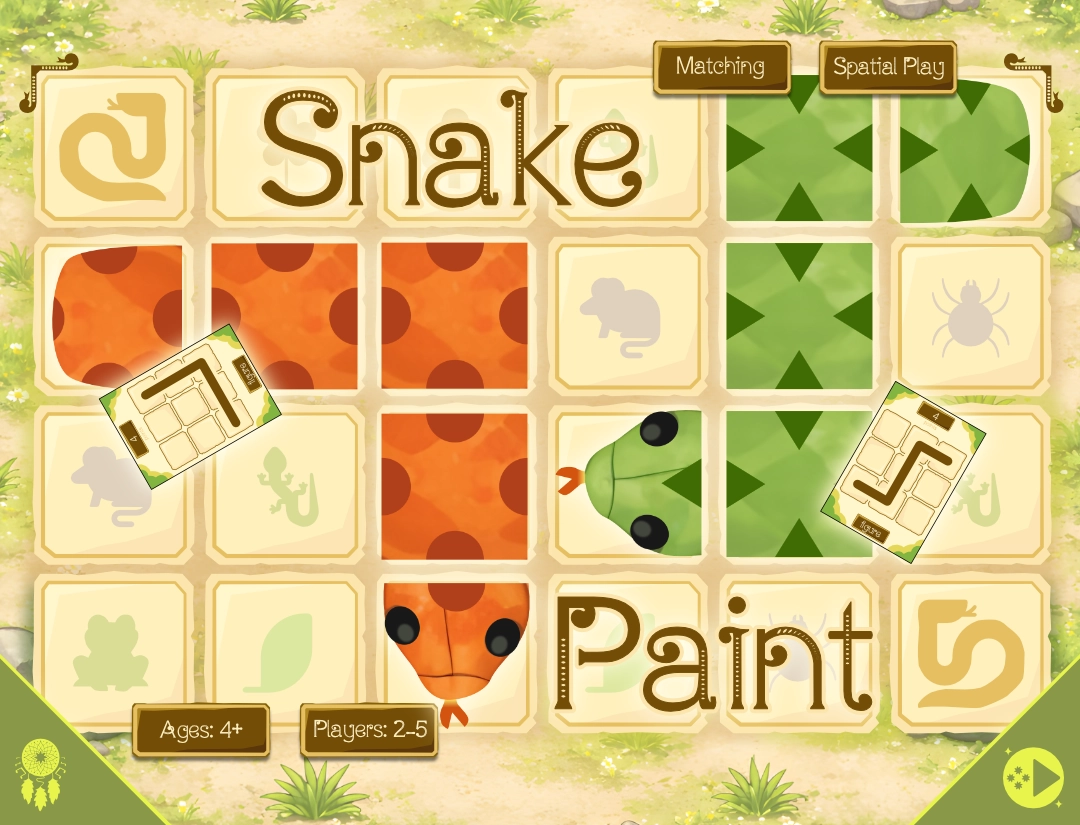
Snakepaint answers the question “what if the classic video game Snake was a board game?” The core idea of snake is really simple and really strong. Kids understand it and can play it, while it gives actual strategy and challenge. That’s why we wanted to translate it to an educational board game.
This game primarily tests the skills of matching and directions (spatial awareness).
- Each round, you play a card from your hand. These cards show simple recognizable icons that are also on the field.
- If your snake is next to that icon, it moves into that space (and grows one space longer).
- If not, you don’t move, but are instead allowed to shorten your snake (by cutting off part of its tail)
Why are you doing all this? Because you want to make a drawing with your snake! You want the snake to look exactly like one of the simple “Figure Cards” on the table. That’s how this game also practices more fine-tuned visual matching ability, such as lines and drawings.
Congratulations, you can already enjoy a game of Snakepaint! The base game is cooperative and simultaneous, so you work together and don’t have to wait on your turn. This allows players to help other players and actually grow through the challenge.
But, of course, we’ve added ways to increase the challenge. Once kids are familiar with the base game, you can introduce simple upgrades that also practice numbers/counting (the length of your snake matters now), or pencil control/fine motor skills (you can draw your own Figure Cards and play the game with those!) You can also play competitively, snake against snake, with the upgrades.
All combined, this game is a fun, fast, simple way to learn those core skills in a variety of ways. By working together on a slithering snake, you try to make its path match your Figure Card, while also using matching to actually tell the snake where to go. As such, the game is textless and numberless, such that young kids can play on their own and you don’t need to have any knowledge of English.
The snakes have a unique color, but also a unique shape/pattern design. As such, it’s not required to print the material in color, although it does make the game look a lot prettier if you do!
Have fun!
Details
- ✔️ Pay once, use forever, however.
- ✔️ No hidden costs or data tracking.
- ✔️ No sign-up required.
- ✔️ No difficult licenses or restrictions.
- ✔️ Instantly arrives in your inbox. (Check spam folder!)
- ✔️ Fun and effective!
Product Contents
- Rulebook PDF (1 front page with information and story, 1 page base game, 2 page upgrades)
- Material PDF (4 pages with different maps to play on, 3 pages with icon cards, 1 page with colored snake parts, 2 pages with Figure Cards/Templates)
- The raw assets (illustrations, layout file, etc) for you to view/edit. (As
.affiles, which you can open with the free Affinity software.)
Fine Details
| Detail | Value |
| Activity Structure | simultaneous |
| Age | 4 |
| Categories | animals |
| Duration | 20 |
| Language | en |
| Level | 1 |
| Multiplayer Mode | cooperative, competitive |
| Player Count | 2, 3, 4, 5 |
| Subject | mathematics, skills |
| Textless | true |
Subject: Mathematics
The curriculum is split into six main subjects that align with your typical school subjects.
This resource is part of the Mathematics subject. Below is a summary:
This subject teaches Mathematics from first principles to calculus. Level 1 explores the basic skills needed before you do any counting or see any numbers (such as grouping and comparing objects). Level 2(+) can then introduce numbers, counting, addition, multiplication, and more.

Faction: Gamiverses
This resource is part of the Gamiverses Faction.
But that's just one way to teach and explore its topic(s)!
You can always move to a different Faction to find a more effective way to teach the same topic.
Played a quiz? Try a game! Played a game? Try an escape room! And so on.
For example,
Charm: Board Game
This product is part of the Board Game charm.
Visit its main page to learn more about what that means. Below is a summary:
Board Games are simply physical games (as opposed to video games). They could be played using cards, without a board, with players physically moving around, anything.
Our board games follow the rule that your first game should only require a single page of setup + rules. Most of them are cooperative multiplayer experiences.
Spell: Recognition & Discrimination
This resource is part of the Recognition & Discrimination topic (or "spell").
A crucial first step to Mathematics and Logic is the ability to recognize things are the same or not. To discriminate between alike things.
This resource also covers other topics. To keep things simple, the curriculum always considers the first topic listed to be the most important.
Use the buttons below to navigate to the previous or next topic in the curriculum.