Description
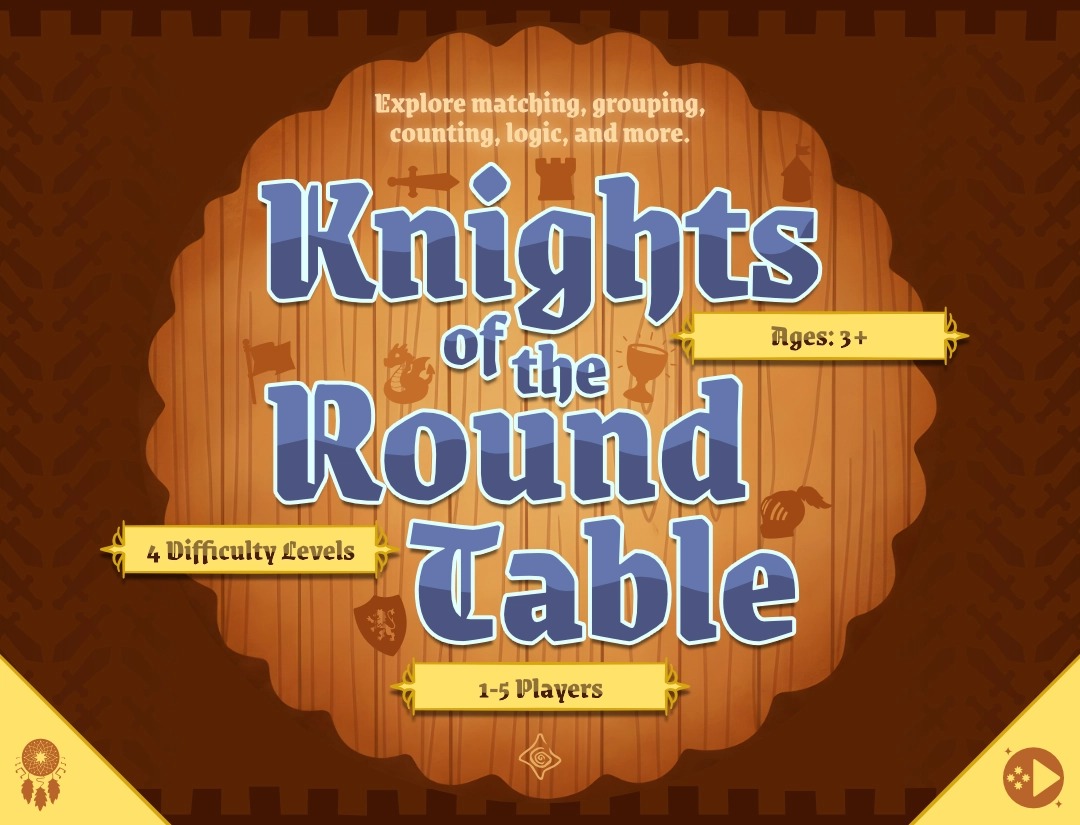
Knights of the Round Table is a physical game about, you guessed it, the famous knights around the round table. You’ll be moving or grabbing King Arthur, Sir Lancelot, and more as you try to remove all Evil Knights or score the best knights for yourself.
The game has 4 different “versions”.
- The base game is extremely simple, playable by kids age 3–4 (and up), and tests visual matching and simple spatial awareness.
- The second version also tests the ability to group alike things, think ahead further, and play competitively (if you want)
- The third version goes even further by practicing numbers and counting skill.
- And the fourth version combines all you’ve learned before for the ultimate challenge. This is a game that is strategic and varied enough that it will be enjoyed by adults, families, anyone.
It’s a “physical game” in the sense that it’s three-dimensional and you’re moving big knight pawns all the time. The Knights are “cones”: cut them out, tape one end to the other, and you have a nice 3D Knight that is easy to grab and can stand on its own.
In fact, this is a very nice craft activity to do together with the kids! We’ve rated “setup” a 2/5 on this game because it will simply take 30+ minutes to prepare those knights, but it’s something kids can do and will love to help with.
The first versions are textless and do not require any reading. It’s as simple as moving Knights or grabbing Knights, arriving at the Round Table or shuffling their seats around. The base game is cooperative (you play together against the game), but the later versions become competitive. The final version includes actions that you’ll need to read or explain beforehand.
As usual, we’ve also included some extra information and trivia about King Arthur’s myths and legends. Use them to set the mood, get kids excited, and make these games even more educational.
The first versions of the game are basically little logic puzzles, made physical and thematic, which is why you can also play those solo. We would always recommend playing games together in a group, but we wanted to at least offer the possibility to play solo. (This is true for most cooperative games. Because it’s you against the game, it can often be you alone against the game too without issues.)
We personally believe that this is one of the best games we’ve ever made. It’s a nice marriage between something very physical and practical (that kids can see and touch and move), very simple thematic rules, and a deep puzzle that will challenge all the crucial Level 1 and Level 2 skills.
Have fun!
Details
- ✔️ Pay once, use forever, however.
- ✔️ No hidden costs or data tracking.
- ✔️ No sign-up required.
- ✔️ No difficult licenses or restrictions.
- ✔️ Instantly arrives in your inbox. (Check spam folder!)
- ✔️ Fun and effective!
Product Contents
- Rulebook PDF (1 front page with information and story, 4 pages with different versions increasing in difficulty)
- Material PDF (6 pages with Round Tables + Extras, 3 pages with Knight Cones, 1 page with Action Tokens, 1 page with Knight Role Cards)
- The raw assets (illustrations, layout file, etc) for you to view/edit. (As
.affiles, which you can open with the free Affinity software.)
Fine Details
| Detail | Value |
| Activity Structure | turn-based |
| Age | 4 |
| Categories | knights |
| Duration | 20 |
| Language | en |
| Level | 1 |
| Multiplayer Mode | cooperative, competitive |
| Player Count | 1, 2, 3, 4, 5 |
| Subject | mathematics, skills |
| Textless | true |
Subject: Mathematics
The curriculum is split into six main subjects that align with your typical school subjects.
This resource is part of the Mathematics subject. Below is a summary:
This subject teaches Mathematics from first principles to calculus. Level 1 explores the basic skills needed before you do any counting or see any numbers (such as grouping and comparing objects). Level 2(+) can then introduce numbers, counting, addition, multiplication, and more.

Faction: Gamiverses
This resource is part of the Gamiverses Faction.
But that's just one way to teach and explore its topic(s)!
You can always move to a different Faction to find a more effective way to teach the same topic.
Played a quiz? Try a game! Played a game? Try an escape room! And so on.
For example,
Charm: Board Game
This product is part of the Board Game charm.
Visit its main page to learn more about what that means. Below is a summary:
Board Games are simply physical games (as opposed to video games). They could be played using cards, without a board, with players physically moving around, anything.
Our board games follow the rule that your first game should only require a single page of setup + rules. Most of them are cooperative multiplayer experiences.
Spell: Recognition & Discrimination
This resource is part of the Recognition & Discrimination topic (or "spell").
A crucial first step to Mathematics and Logic is the ability to recognize things are the same or not. To discriminate between alike things.
This resource also covers other topics. To keep things simple, the curriculum always considers the first topic listed to be the most important.
Use the buttons below to navigate to the previous or next topic in the curriculum.