Description
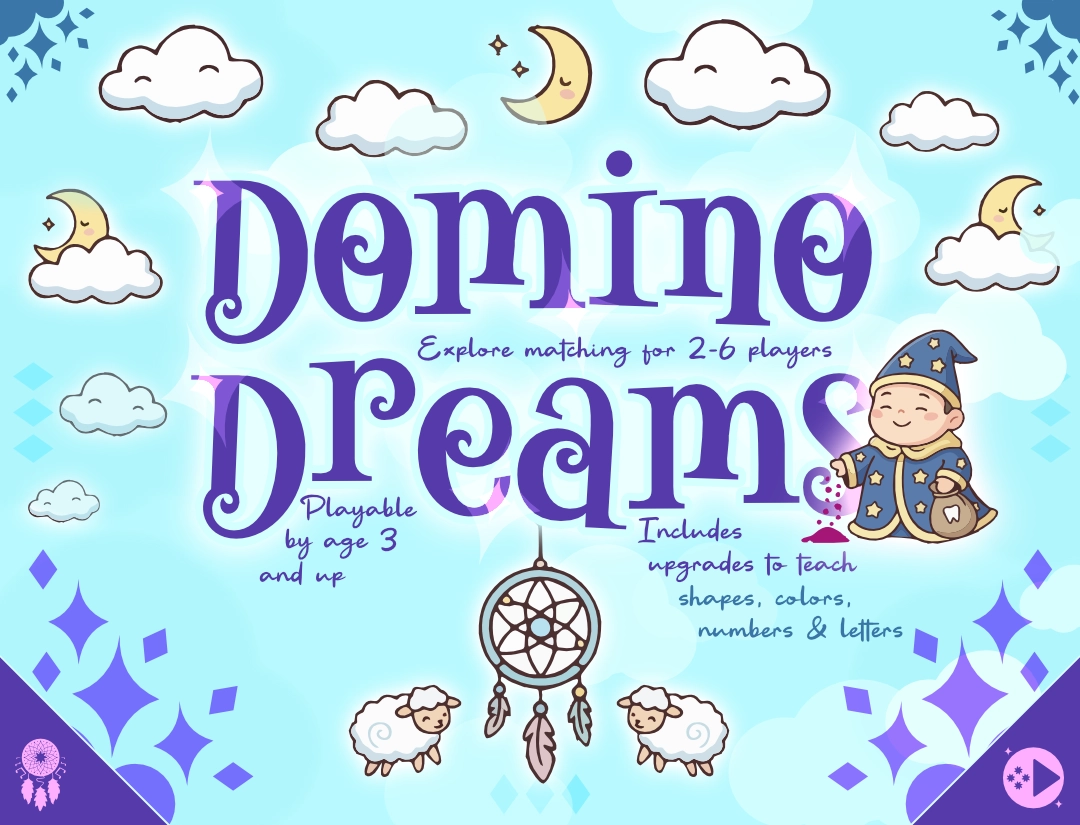
Domino Dreams is a beautiful game about matching icons and placing dominoes. You pick a domino at the same time and discuss (as a group) in what order you want to add them to the map. As expected, dominoes are only allowed next to a matching icon, and failing to do so moves the Moon Pawn forward. Make sure you finish the map before the night ends (and you “wake up”)!
The base game is meant to be played with young kids, perhaps as one of the first games they ever played. The Upgrades add all sorts of extra dominoes and keep it interesting for older ages. For example, they teach numbers/letters too, and add a competitive version.
Domino pieces are great! Any game with them becomes interesting and strategic by default, but they’re still very intuitive for children. They are large, they must match, and they are cooperative (if you add them to the same map). A great way to learn matching, while also taking into account spatial properties and the best order in which to play them. There’s a reason domino games are often the first games young kids play.
This game in particular has a simple core that is everything but simple to win, even for adults, as you’re rewarded for planning ahead and great cooperation. The theme around sleep, dreams, and day/night cycle was picked because it’s intuitive and recognizable to young kids.
To play the game, you only need to find one common household object (a button, a stone, a pawn from another game, anything). That is, of course, besides printing and cutting this PDF file you bought! We decided to do this because it is a waste of paper/ink to add special pawns when they are only used for a single thing, and because a physical pawn is so much nicer to use (especially for kids) than a paper one anyway.
We also split the material into two PDF files. The base game material does not need to be printed in color, it works just fine in grayscale. But the other PDF, with a few expansions inside, does need to be printed in color. It’s all we can do to be as sustainable and ink friendly as possible!
Details
- ✔️ Pay once, use forever, however.
- ✔️ No hidden costs or data tracking.
- ✔️ No sign-up required.
- ✔️ No difficult licenses or restrictions.
- ✔️ Instantly arrives in your inbox. (Check spam folder!)
- ✔️ Fun and effective!
Product Contents
- Rulebook PDF (1 front page with information and story, 1 page base game, 2 pages with upgrades)
- Material PDF (4 pages base game dominoes, 4 pages expansion dominoes)
- Material PDF Color (5 pages expansion dominoes that MUST be printed in color)
- The raw assets (illustrations, layout file, etc) for you to view/edit. (As
.affiles, which you can open with the free Affinity software.)
Fine Details
| Detail | Value |
| Activity Structure | simultaneous |
| Age | 4 |
| Duration | 20 |
| Language | en |
| Level | 1 |
| Multiplayer Mode | cooperative, competitive |
| Player Count | 2, 3, 4, 5, 6 |
| Subject | mathematics |
| Textless | true |
Subject: Mathematics
The curriculum is split into six main subjects that align with your typical school subjects.
This resource is part of the Mathematics subject. Below is a summary:
This subject teaches Mathematics from first principles to calculus. Level 1 explores the basic skills needed before you do any counting or see any numbers (such as grouping and comparing objects). Level 2(+) can then introduce numbers, counting, addition, multiplication, and more.

Faction: Gamiverses
This resource is part of the Gamiverses Faction.
But that's just one way to teach and explore its topic(s)!
You can always move to a different Faction to find a more effective way to teach the same topic.
Played a quiz? Try a game! Played a game? Try an escape room! And so on.
For example,
Charm: Board Game
This product is part of the Board Game charm.
Visit its main page to learn more about what that means. Below is a summary:
Board Games are simply physical games (as opposed to video games). They could be played using cards, without a board, with players physically moving around, anything.
Our board games follow the rule that your first game should only require a single page of setup + rules. Most of them are cooperative multiplayer experiences.
Spell: Recognition & Discrimination
This resource is part of the Recognition & Discrimination topic (or "spell").
A crucial first step to Mathematics and Logic is the ability to recognize things are the same or not. To discriminate between alike things.
This resource also covers other topics. To keep things simple, the curriculum always considers the first topic listed to be the most important.
Use the buttons below to navigate to the previous or next topic in the curriculum.